
African Grey Parrot Training: A Complete Scientific Guide to Taming and Teaching Speech
Learn to train an African grey parrot using modern, science-based methods built on positive reinforcement: taming, teaching speech, recall, and proper nutrition.
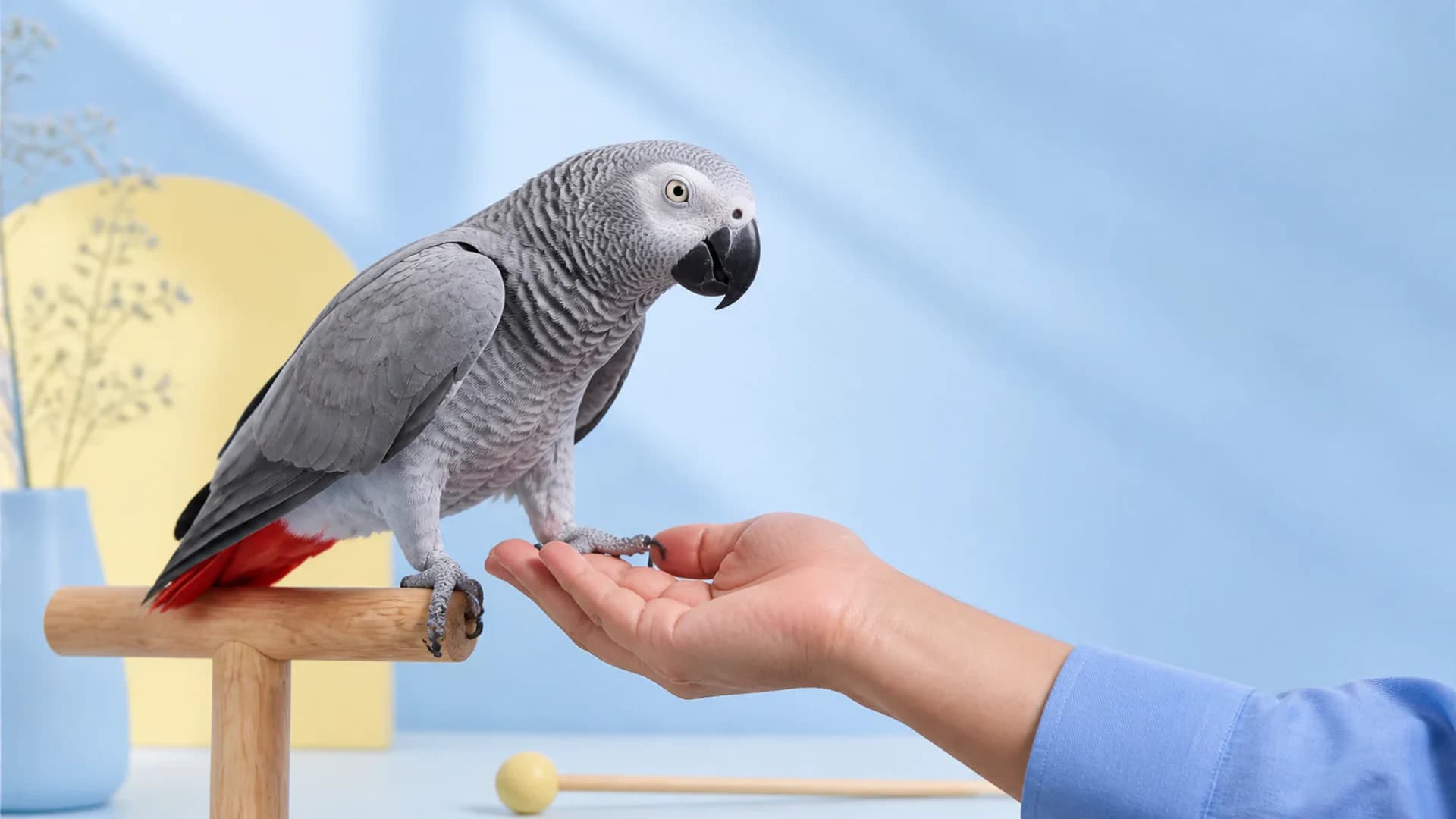
2026 Comprehensive Scientific Guide · Updated
Successful African grey training starts with understanding one fact: you're not dealing with an ordinary bird, but with one of the most intelligent creatures on Earth. The African grey parrot (Psittacus erithacus) has cognitive abilities comparable to a five-year-old child, which means taming it and teaching it to talk both rest on building trust and positive reinforcement, not on coercion or dominance. In this guide you'll find practical protocols based on the latest research in neuroscience and behavioral medicine, taking you step by step from day one through to mastering advanced commands.
Why Is Training an African Grey Different From Other Birds?
Before any protocol, you need to understand how the African grey's brain works. The bird has two brain regions that govern its behavior during training: the NCL, responsible for working memory and decision-making, and the mesopallium, responsible for long-term emotional memory. This structure means its experiences — negative and positive alike — become deeply ingrained for years.
A striking scientific fact: a single traumatic incident (such as being forcibly restrained) can be enough to create a lasting phobia that persists for years, because the African grey's emotional memory is exceptionally sticky. Trust is built drop by drop and lost in bulk.
From this neurological foundation come three rules that govern every step of taming an African grey:
- Emotional memory outweighs logic: any coercion or harsh reaction gets registered as a withdrawal from the bird's "trust account."
- Stress shuts down learning: stress hormones prevent the brain from storing information, so a stressful session is a failed session.
- African greys understand cause and elimination: they analyze situations rather than blindly repeating behavior, which makes them a partner in learning rather than a passive recipient
The Golden Rule: Positive Reinforcement, No Dominance
Modern behavioral research unanimously rejects "dominance theory" entirely; an African grey isn't looking for a leader to impose control, but for a safe partner whose actions it can predict. That's why scientifically proven behavior-modification methods rely on only two approaches:
- Positive reinforcement (R+): delivering a desired stimulus immediately after the wanted behavior occurs, to increase how often it happens. This is the cornerstone of all training.
- Negative punishment (P−): withdrawing a desired stimulus to reduce an unwanted behavior — such as withdrawing your attention and looking away for 30–60 seconds after a bite.
Warning: "positive punishment" methods (yelling, spraying with water, confining the bird) are scientifically prohibited; they produce a state of "learned helplessness" in which the bird gives up and becomes depressed, and they destroy your relationship with it.
How Do You Choose the Right Reward for Training an African Grey?
The reward is the "currency" of training, and its value is set by the bird, not by you. An African grey is a natural-born economist: it won't put in real effort for a cheap reward. The solution is a three-tier value system:
- Tier 1 — everyday reward: to reinforce familiar behaviors, such as balanced pellets and vegetable pieces.
- Tier 2 — training reward: for teaching new behaviors and for short sessions, such as small pieces of walnut or almond and sunflower seeds.
- Tier 3 — the "jackpot": for a major achievement or overcoming a fear barrier, such as a piece of its favorite nut, withheld entirely for the rest of the day.
To precisely identify your bird's "currency," use the "choice buffet" protocol: place a dish with 5–6 different rewards in front of it for two minutes, and record what it picks up first (the winner), then what follows. The top three become your approved rewards.
The golden three-second rule: the reward must arrive within 3 seconds of the desired behavior; otherwise the bird links it to a different behavior and you end up reinforcing the wrong thing by accident. Also make sure total rewards never exceed 5% of its daily food intake.
Proper Nutrition: Fuel for Brain and Body
There's no effective training on a poorly nourished body. The number-one cause of illness in pet parrots is obesity and calcium deficiency resulting from a fatty seed-based diet. The scientifically balanced diet rests on three pillars:
- Balanced pellets — 75–80%: the base of the meal, for complete, calculated nutrition.
- Fresh vegetables — 15–20%: dark leafy greens, carrots, sweet peppers, low in sugar.
- Fruit — 5%: as a source of vitamins and as a treat, not as a staple.
Lethal foods — 0% tolerance: avocado, chocolate, caffeine, alcohol, onion, garlic, and fruit pits. These are toxic to African greys and can be fatal, so don't make exceptions for anyone.
The Best Age to Train an African Grey and Its Growth Stages
Every age has an optimal learning window and suitable methods. Choosing the right timing doubles the effectiveness of training, and ignoring it can backfire:
- The golden window (weaning – 6 months): priority goes to social normalization and positive exposure to everything new.
- Peak learning age (6 months – 2 years): basic commands such as targeting, step-up, recall, and the marker.
- Maturity and mastery (2 – 5 years): compound commands, sentences, and movement sequences.
- Wisdom and renewal (5 years and up): continuous novelty and preventing boredom — learning continues for life.
Reassuring fact: it's never "too late," period. Parrots aged 20 and 30, suffering from severe phobias, have been successfully rehabilitated. An older bird may simply need more time.
Trust-Building Protocols (The Foundation Before Everything Else)
These protocols are the foundation for any later training, and their goal is building a cooperative relationship, not "taming" the bird in the old sense of the word. Follow them in order:
1) Parallel presence (for fearful or new birds)
Sit next to the cage daily, reading or working quietly, and speak in a low voice without reaching your hand in. Place a small reward near the door and walk away. The goal is building a "trust account" from zero, with no pressure.
2) Charging the "marker"
Choose a short, neutral sound (a tongue click or the word "good"), make the sound, then immediately deliver a reward, and repeat this 10–15 times a day. The bird will learn that this sound means "a reward is coming," turning it into your tool for precisely marking the right behavior.
3) Targeting
Teach it to touch the tip of a small stick. Present it a centimeter away, and the moment it touches it, give the marker and reward it. This skill lets you direct it from one place to another without touching it — a magic tool that makes it feel in control and safe.
4) Step-up
Present your hand as a stable perch at chest height, and when it steps up, reward it with a "jackpot." The golden rule here: never restrain the bird. Always keep the exit open, since its trust doubles once it knows it's free to step back down.
How Do You Teach an African Grey to Talk?
An African grey doesn't mimic sounds randomly — it learns words tied to meanings and emotions. So the most successful method is the model/rival approach, backed by linking words to meaning:
- Create a clear sound environment: narrate your daily actions with consistent words ("hello," "red apple," "playtime") in an enthusiastic, positive tone.
- Link the word to its meaning: bring a real apple, say "apple," then give it a piece, and repeat this in short sessions.
- Apply the model/rival method: have one person ask another, in front of the bird, "What's this?" who answers "apple" and is enthusiastically rewarded. The bird's jealousy over your attention to the "rival" drives it to imitate the word.
- Shape the sound gradually (vocal shaping): reward any close-enough sound first ("ap..."), then raise the bar until the full word.
Common mistakes that derail teaching speech: talking too fast, teaching too many words at once, teaching words without linking them to meaning, and getting frustrated when the bird doesn't talk. Patience and clarity are the key.
Recall Training: The Safe Alternative to Wing Clipping
Wing clipping is physically and psychologically harmful, and the only scientifically sound alternative is recall training: building a reliable response that makes the bird fly to you when called, which can save its life if it ever gets out by accident. Start on the ground from a distance of 15 cm, use a consistent verbal cue, reward every step closer with a "jackpot," then gradually increase the distance and the height.
Safety rule: never call the bird for something it dislikes (such as being restrained or given medicine). Recall must always stay a positive act, tied only to reward.
Training Tricks and Movements
An African grey isn't just a talker; it's an athlete that needs mental and physical stimulation. The training principle here is "shaping": breaking a complex movement down into simple steps that are rewarded one after another. Some of the easiest movements to start with:
- Turn around: move the reward around its body to make it turn, and reward it while adding the verbal cue "turn."
- Wing up: catch the natural moment it raises its wing and reward it — useful for veterinary exams later on.
- Play dead: a move that builds deep trust and makes veterinary exams easier.
Keep the session to no more than 10 minutes, and never physically force it; if it refuses a movement, back up one step.
Cognitive Enrichment and Foraging
Providing an outlet for the "foraging" instinct isn't a luxury — it's a mandatory veterinary prescription for mental health, since it can cut feather-plucking behavior by up to 70%. In practice: make the bird work for 60–80% of its food by hiding it in foraging toys, wrapping it in clean paper, or placing it inside small boxes it can tear apart.
Cognitive enrichment: toys that mimic the bird's natural instincts, occupy its long hours, and demonstrably reduce feather-plucking behavior and boredom
The Ideal Daily Schedule for an African Grey
- 7:30 am — Uncover the cage and greet it in a calm voice.
- 8:00 am — Focused training session (10–15 minutes) with the highest-value reward.
- 8:30 am — Main meal (pellets + vegetables).
- 9:00 am – 12:00 pm — Foraging time and free activity (a mandatory prescription).
- 5:00 pm — Family social interaction and vocal learning.
- 7:00 pm — Recall session and trick review (10 minutes).
- 8:00 pm — Cover the cage for uninterrupted sleep of 10–12 hours.
Frequently Asked Questions About Training an African Grey
What's the best age to start training an African grey?
The best window is from weaning to 6 months for social normalization, followed by 6 months – 2 years for learning commands. But it's never too late; older birds can also learn, though they may need more time and patience.
How long does it take an African grey to learn to talk?
The first sound attempts usually appear between 3 and 6 months of consistent training, and a clear word between 6 and 12 months. This depends on linking the word to meaning and on keeping short daily sessions consistent.
How do I stop my African grey from biting?
Avoid yelling or spraying it. Use negative punishment: withdraw your attention and look away for 30–60 seconds right after the bite, and reinforce calm behavior with rewards. Biting is often the result of fear or being forced, so build trust first.
Is wing clipping necessary for an African grey?
No. Wing clipping causes physical and psychological harm. The safe alternative is reliable recall training, which preserves the bird's ability to fly while still keeping it safe.
How long should a training session be?
10 to 15 minutes at most, once or twice a day. Frequent short sessions are more effective than one long session that exhausts the bird and breaks its focus.
Scientific Sources
These guidelines are based on peer-reviewed research in neuroscience and behavioral veterinary medicine, including the work of Pepperberg (2022), Güntürkün & Bugnyar (2016), and Heidenreich (2019). For more trusted veterinary references on applied behavior analysis in parrots, see LafeberVet and the Association of Avian Veterinarians (AAV).LafeberVetAssociation of Avian Veterinarians (AAV)
You may also enjoy
Parrot Body Language: How to Understand What Your Bird Is Telling You (2026)
Learn to read your parrot's body language: eye pinning, feather fluffing, tail movements, and what biting really means — with a practical summary that helps you understand your bird in the moment and avoid getting bitten.
Read article
Raising the Indian Ringneck: The Complete Beginner's Guide (2026)
The complete guide to raising an Indian ringneck: the right cage size, the daily food pyramid, toxic foods, illness signs, and teaching it to talk step by step.
Read article
Weaning Bird Chicks: An Age Guide by Species (2026)
A complete step-by-step guide to weaning bird chicks: weaning ages for every species from budgies to African greys, readiness signs, and mistakes that threaten a chick's health. Read before you start.
Read article